
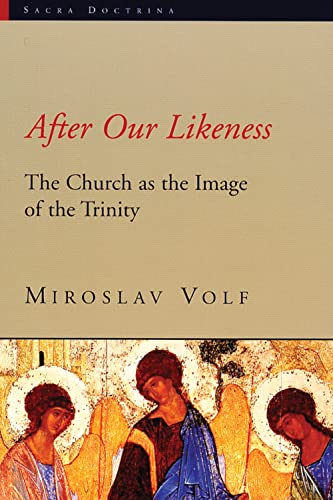
After our Likeness The Church as the Image of the Trinity Miroslav Volf
Material type: TextLanguage: English Series: Sacra doctrina (Series)Publication details: U.S.A.; William B. Eerdmans Pub. Co.; 1998Description: 314tr; Paperback, illustrations; 24 cmISBN:
 - 9780802844408
- 262
- M676-V90
| Cover image | Item type | Current library | Home library | Collection | Shelving location | Call number | Materials specified | Vol info | URL | Copy number | Status | Notes | Date due | Barcode | Item holds | Item hold queue priority | Course reserves | |
|---|---|---|---|---|---|---|---|---|---|---|---|---|---|---|---|---|---|---|
 Sách
Sách
|
Thư Viện Cơ Đốc | Available | TVCD-13093 |
In After Our Likeness, Miroslav Volf explores the relationship between persons and community in Christian theology. The focus is the community of grace, the Christian church. The point of departure is the thought of the first Baptist, John Smyth, and the notion of church as ""gathered community"" that he shared with Radical Reformers. Volf seeks to counter the tendencies toward individualism in Protestant ecclesiology and to suggest a viable understanding of the church in which both person and community are given their proper due. In the process, Volf engages in a sustained and critical ecumenical dialogue with the Catholic and Orthodox ecclesiologies of Joseph Cardinal Ratzinger and the metropolitan John Zizioulas. The result is a study that spells out a vision of the church as an image of the triune God.
There are no comments on this title.