
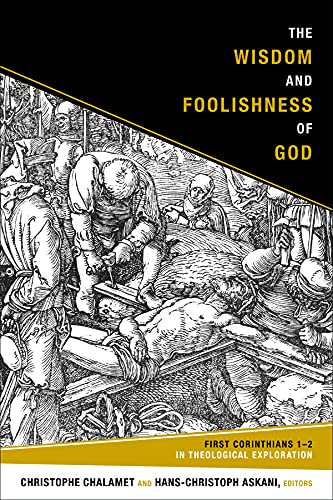
The wisdom and foolishness of God First Corinthians 1-2 in theological exploration Christophe Chalamet
Material type: TextLanguage: 0 eng Publication details: Minneapolis, USA; The Fortress; 2015pgs.Description: 393tr; PaperbackISBN:
 - 9781451490206
- 227.066
- C556-C44
| Cover image | Item type | Current library | Home library | Collection | Shelving location | Call number | Materials specified | Vol info | URL | Copy number | Status | Notes | Date due | Barcode | Item holds | Item hold queue priority | Course reserves | |
|---|---|---|---|---|---|---|---|---|---|---|---|---|---|---|---|---|---|---|
 Sách
Sách
|
Thư Viện Cơ Đốc | Available | TVCD-5840 |
The first two chapters of Paul's first epistle to the Christians of Corinth, written in the fifth decade of the first century, have played a significant role in the history of Christian theology. Interpreting the central event in Christianity, namely the crucifixion of Jesus, Paul reflects on the wisdom and foolishness of God, which he opposes to the world's wisdom. According to Paul, the `word of the cross,` which is `foolishness` to some and `scandal` to others, leads to an upheaval in one's way of thinking. For two millennia, theology has often turned to these passages in order to sustain its reflection. Many central questions emerge from Paul's text on the meaning of a crucified Messiah, on God's omnipotence, weakness, and suffering. This volume hopes to achieve two things by seeking to place exegetes, historians, philosophers, and theologians in conversation: to better understand Paul's text and its reception and also to examine the ways in which it can nourish our theological reflection today.
There are no comments on this title.