
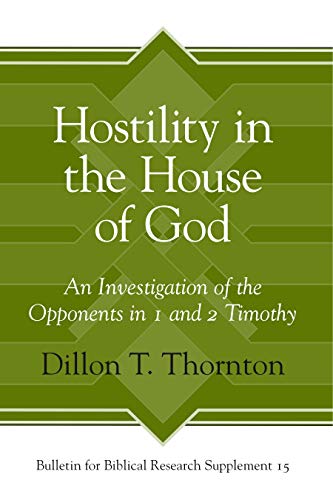
Hostility in the house of God An investigation of the opponents in 1 and 2 Timothy Dillon T. Thornton
Material type: TextLanguage: 0 eng Publication details: U.S.A; Eisenbrauns; 2016Description: 322tr; Hardcover; 23cmISBN:
 - 9781575064468
- 227.8306
- D579-T51
| Cover image | Item type | Current library | Home library | Collection | Shelving location | Call number | Materials specified | Vol info | URL | Copy number | Status | Notes | Date due | Barcode | Item holds | Item hold queue priority | Course reserves | |
|---|---|---|---|---|---|---|---|---|---|---|---|---|---|---|---|---|---|---|
 Sách
Sách
|
Thư Viện Cơ Đốc | Available | TVCD-6288 |
Virtually all scholars acknowledge the presence of opponents in 1 and 2 Timothy, but there is considerable disagreement over the identity of these opponents and the author's way of handling them. In this volume, Thornton provides a critique of a number of extant theories, including `Gnostic,` Jewish, and proto-Montanist identifications, and develops a rigorous methodology for unmasking the opponents who appear in these letters. He argues that the opponents came from within the Christian community in Ephesus and that their teaching is best described as an erroneous eschatological position that derived from the complexity of Paul's views. He also argues that the author of the books of Timothy engaged with the false teachers in significant ways throughout the letters, and draws attention to a number of literary and theological maneuvers that were intended to counteract the opponents' influence and/or to bolster the faithful community's confidence as it struggled against the opponents. Thornton's meticulous investigation sheds new light on the hostility that plays such a large part in 1 and 2 Timothy.
There are no comments on this title.