
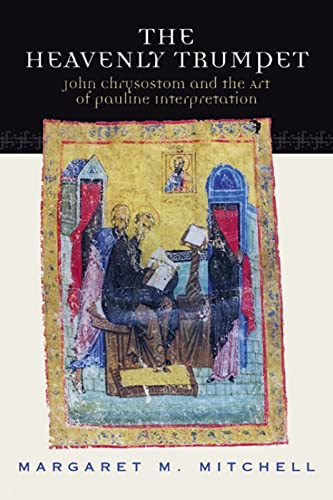
The heavenly trumpet John Chrysostom and the art of Pauline interpretation Margaret Mary Mitchell
Material type: TextLanguage: 0 eng Publication details: U.S.A; Westminster John Knox; 2002Description: 563tr; Paperback; 23cmISBN:
 - 0664225101
- 227.06092
- M327-M68
| Cover image | Item type | Current library | Home library | Collection | Shelving location | Call number | Materials specified | Vol info | URL | Copy number | Status | Notes | Date due | Barcode | Item holds | Item hold queue priority | Course reserves | |
|---|---|---|---|---|---|---|---|---|---|---|---|---|---|---|---|---|---|---|
 Sách
Sách
|
Thư Viện Cơ Đốc | Available | TVCD-8405 |
Arguing that all Pauline interpretation depends significantly on how readers formulate their own images of the apostle, Margaret M. Mitchell posits that John Chrysostom, the most prolific interpreter of the Pauline epistles in the early church, exemplifies this phenomenon. Mitchell brings together Chrysostom's copious portraits of Paul--of his body, his soul, and his life circumstances--and for the first time analyzes them as complex rhetorical compositions built on well-known conventions of Greco-Roman rhetoric. Two appendices offer a fresh translation of Chrysostom's seven homilies de laudibus Sancti Pauli and a catalog of color plates of artistic representations that graphically represent the author/exegete dynamic this study explores.
There are no comments on this title.