
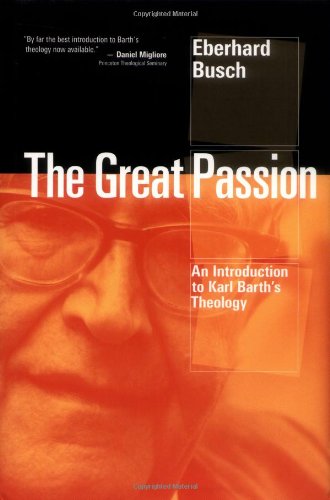
The great passion An introduction to Karl Barth's theology Eberhard Busch
Material type: TextLanguage: 0 eng Publication details: U.S.A; William B. Eerdmans; 2004Description: 302tr; Hardcover; 24cmISBN:
 - 0802848931
- 230.044092
- E16-B98
| Cover image | Item type | Current library | Home library | Collection | Shelving location | Call number | Materials specified | Vol info | URL | Copy number | Status | Notes | Date due | Barcode | Item holds | Item hold queue priority | Course reserves | |
|---|---|---|---|---|---|---|---|---|---|---|---|---|---|---|---|---|---|---|
 Sách
Sách
|
Thư Viện Cơ Đốc | Available | TVCD-8567 |
In ten sections Eberhard Busch clearly explains Karl Barth's views on all of the major subject areas of systematic theology: the nature of revelation, Israel and Christology, the Trinity and the doctrine of predestination, the `problem` of religion, gospel and law, creation, salvation, the Holy Spirit, ecclesiology, and eschatology.` `A distinctive feature of the book is the way Busch lets Barth speak for himself, often through surprising quotations and paraphrases. Busch also shows how Barth's writing should be read as a dialogue, constantly and consciously engaging other voices past and present, both inside and outside the church. Most important, The Great Passion demonstrates that Barth's thought is still remarkably helpful today.
There are no comments on this title.