
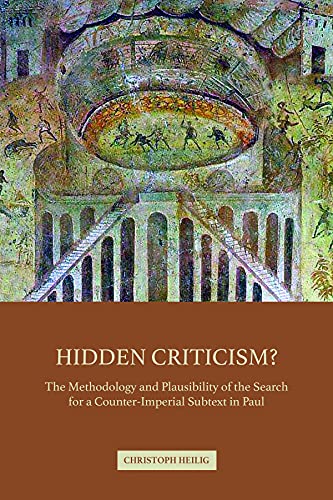
Hidden criticism? The methodology and plausibility of the search for a counter-imperial subtext in Paul Christoph Heilig
Material type: TextLanguage: 0 eng Publication details: U.S.A.; Fortress; 2017Edition: 2ndDescription: 199tr; Paperback; 23cmISBN:
 - 9781506428123
- 225
- C556-H47
| Cover image | Item type | Current library | Home library | Collection | Shelving location | Call number | Materials specified | Vol info | URL | Copy number | Status | Notes | Date due | Barcode | Item holds | Item hold queue priority | Course reserves | |
|---|---|---|---|---|---|---|---|---|---|---|---|---|---|---|---|---|---|---|
 Sách
Sách
|
Thư Viện Cơ Đốc | Available | TVCD-8781 |
Paul has been regarded as being uncritical of the Roman Empire for a long time, not least because of his apparent call to obey the state in Romans 13:1-7. However, recent scholarship has questioned this assumption by pointing to `hidden criticism` in the letters of the apostle. But how can we decide, in a methodologically sound way, whether such a counter-imperial message lies beneath the surface of the text? Based on insights from the philosophy of science, Christoph Heilig suggests several analytical steps for examining this paradigm. He concludes that the hypothesis that we can identify critical `echoes` of the Roman Empire in Paul's letters needs to be modified if it is to be maintained. In particular, the hypothesis of Paul's concern that any overt criticism would be dangerous and lead to subsequent persecution of himself or his congregations is dubious and does not sufficiently justify this interpretative approach. Nevertheless, Heilig concludes that the search for a counter-imperial subtext in Paul could turn out to be heuristically fruitful, so long as the limitations of the approach are heeded. Hence, a reevaluation of Pauline passages in light of Paul's engagement with ideas from his Roman environment is encouraged.
There are no comments on this title.